


The Smart Grid Action Plan
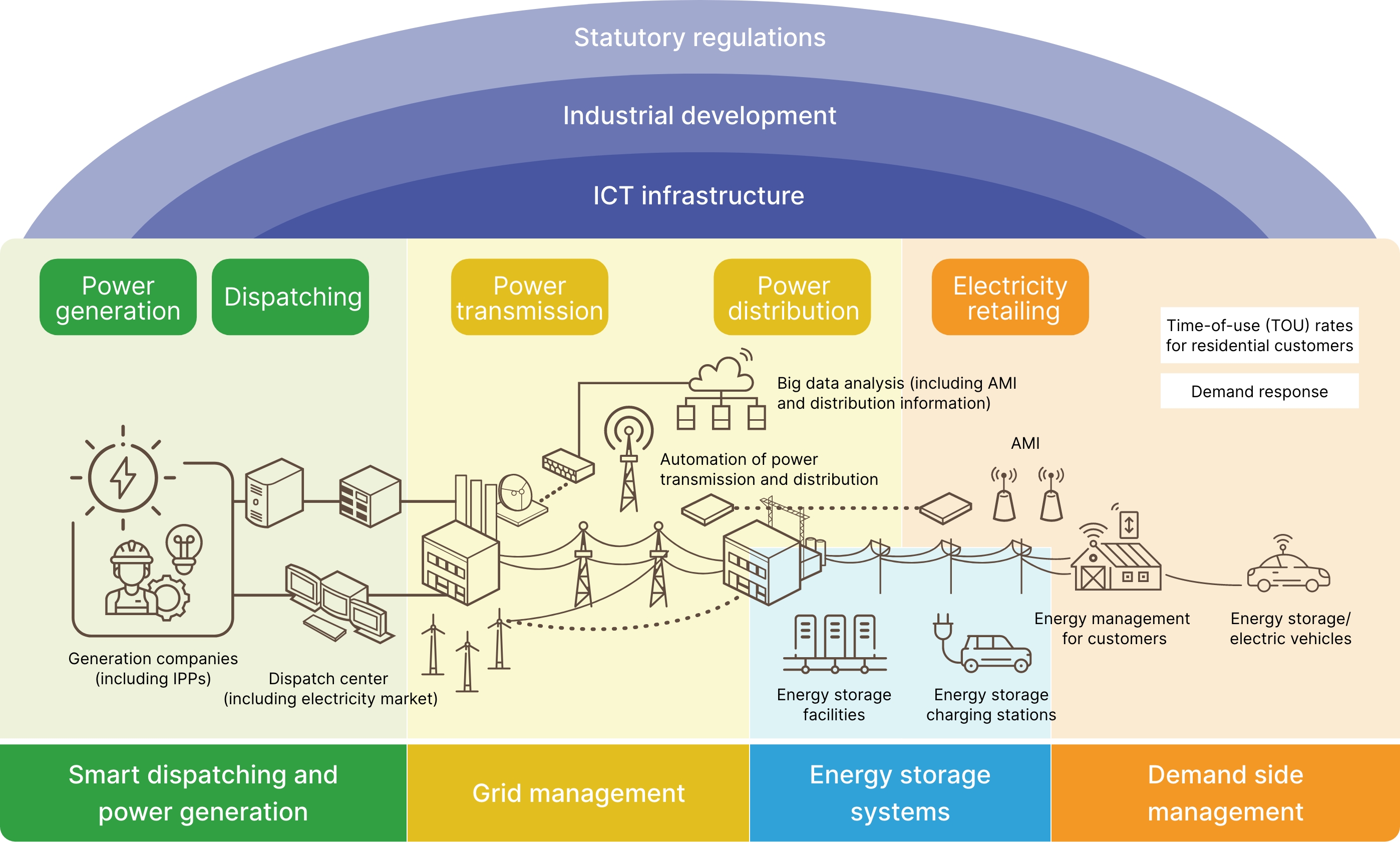
Smart grids are vital to driving energy transition and industrial development. Taipower is dedicated to mitigating the intermittency of renewable energy generation, enhancing grid resilience,improving transmission and distribution integration,and strengthening disaster response and troubleshooting. It also aims to optimize supply-demand management and boost user participation to build an efficient and stable smart grid.
The primary goals of smart grid development are:
- addressing the challenges of integrating renewable energy
- strengthening existing grid resilience to improve power quality and cope with extreme weather; and
- encouraging user participation in energy conservation to enhance power system efficiency.
Taipower has been implementing smart grid infrastructure based on the Smart Grid Master Plan which was approved and revised by the Executive Yuan on March 27,2020.The plan is structured around problem-solving and system integration, with 7 strategic areas,21 specific measures, and 14 key checkpoints. Taipower is responsible for 6 of the 7 areas,17 of the specific measures, and 13 of the key checkpoints. It continues to implement and regularly review progress to enhance energy management and grid resilience.
On March 27, 2020, Taipower began to carry out smart grid construction in accordance with The Smart Grid Master Plan as approved and amended by the Executive Yuan’s Bureau of Energy. The plan is oriented towards problem-solving and system integration, and is divided into 7 key strategic areas, 21 specific practices, and 14 checkpoint objectives. Taipower is mainly responsible for six areas, 17 specific practices, and 13 checkpoint targets. The Company continuously implements and reviews its performance in these areas to strengthen its energy management and grid resilience.
Smart Grid Performance in 2025
In 2025, Taipower continued to promote smart grid-related applications by integrating real-time renewable energy generation status, the Distributed Renewable Energy Advanced Management System (DREAMS), energy storage systems, and demand-side management mechanisms, continuously improving grid dispatch efficiency and operational flexibility.
The real-time monitorable renewable energy capacity reached
9.52
GW
The average failure time of transmission system equipment was maintained at
0.02
hours per year
The installed capacity of energy storage systems reached
1,949.9
MW
As of the end of 2025, Taipower had completed the installation of
4.107
million advanced metering infrastructure (AMI) meters