


Ecological Coexistence and Nature-related Risk and Opportunity Management
Taskforce on Nature-related Financial Disclosures (TNFD)
Implementation Background
In response to international disclosure standards and nature-related risks, Taipower launched its TNFD (Taskforce on Nature-related Financial Disclosures) framework in 2024. Following TNFD Recommendations, the LEAP approach, and electric utility sector guidance, the company is systematically establishing a nature-risk management mechanism tailored to its utility operations.
Governance Structure
In 2024, Taipower formally launched its TNFD initiative following approval by the Chairman at the Sustainable Development Commission. By 2025, nature-related risk and opportunity management was integrated into board-level medium- and long-term targets, supervised by the Sustainable Development and Risk Management Committee. The Sustainable Environment Promotion Task Force (E Group) leads execution in coordination with headquarters and operational units.
Management Mechanism
Taipower established a nature-risk management framework tailored to utility operations by benchmarking international trends, evaluating environmental impact assessments, and analyzing power-sector nature issues. Through cross-departmental workshops, training, and expert consultation, the company collects operational data to assess dependencies and impacts on natural ecosystems, identifying key nature-related risks and opportunities to formulate targeted strategic responses.
Human Rights and Stakeholder Engagement
Taipower also considers human rights policies and stakeholder engagement in its TNFD process. Where nature-related risks or opportunities may affect Indigenous peoples, local communities, or other stakeholders, on-site units respond through environmental impact assessment commitments, stakeholder engagement, and community measures, with oversight and rolling reviews by responsible departments.
Implementation Strategy and Scope
To manage its widespread operational footprint, Taipower applies a phased TNFD rollout, starting with high-risk demonstration sites before scaling company-wide. Following the successful completion of its coal-fired pilot at the Linkou Power Plant in 2025, Taipower plans to expand TNFD implementation across all coal-fired plants in 2026 while initiating demonstration projects for gas-fired and hydroelectric power sites.
Taipower's Phased TNFD Implementation Plan
Priority Site Demonstration |
Parallel Implementation |
Full Scope Coverage of Direct Operations |
|
Demonstration at Priority Sites |
System-Wide Implementation |
Company-Wide Review |
Linkou Power Plant Demonstration Case
Linkou Power Plant Demonstration Case Taipower used the Linkou Power Plant as a demonstration site, adopting the Locate, Evaluate, Assess, and Prepare (LEAP) steps in accordance with various TNFD guidelines to drive the implementation.
Evaluating Nature-related Dependencies and Impacts
Evaluating Nature-related Dependencies and Impacts Taipower collected operating data from the Linkou Power Plant to assess the dependencies and impacts of its direct operations on nature.
The Linkou Power Plant Assessment Results for Nature Dependencies and Impacts (E)
| Category | Operational Data | Ecosystem Services |
|---|---|---|
| Resource Use - Energy | [Dependency] Electricity Use | Provisioning / Supporting Services |
| Resource Use - Resources | [Dependency] Water Resource Use | Provisioning / Supporting Services |
| [Dependency] Total Spatial Footprint | Provisioning / Supporting Services | |
| Climate Change | [Impact] GHG Emissions | Regulating Services |
| Pollution | [Impact] Non-GHG Emissions | Regulating Services |
| [Impact] Soil Quality | Supporting Services | |
| [Impact] River Discharge | Regulating Services | |
| [Impact] Marine Discharge | Regulating Services | |
| [Impact] Waste | Regulating Services | |
| [Impact] Light Pollution | Regulating Services | |
| [Impact] Noise | Regulating Services | |
| Invasive Species | [Impact] Invasive Species | Regulating Services |
| Endangered Species | [Impact] Endangered Species | Provisioning / Supporting Services |
| Disaster Protection | [Impact] Disaster Potential | Provisioning / Supporting Services |
Identification of Nature-related Risks and Opportunities
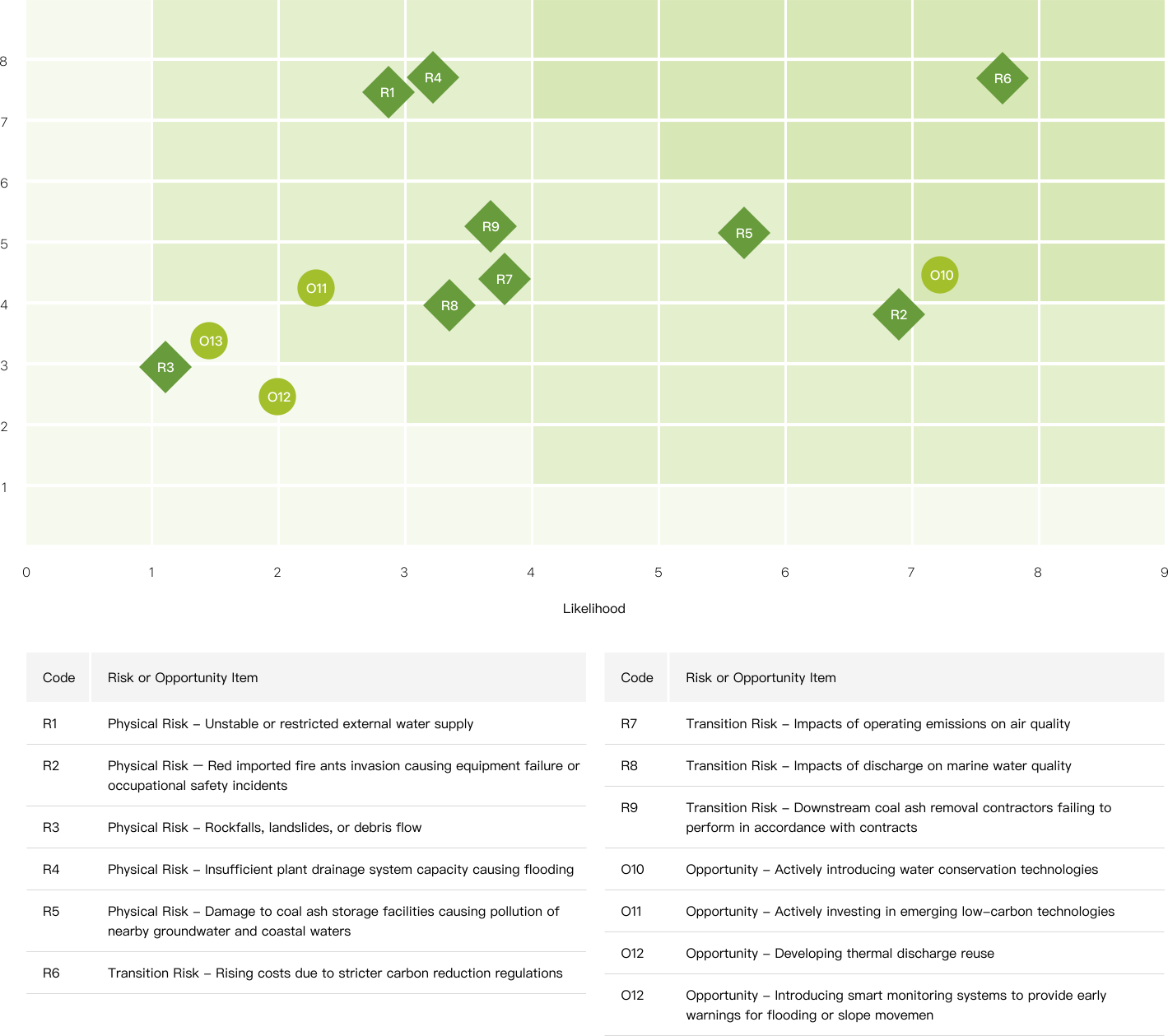
Taipower evaluates physical and transition risks across operations with high nature dependencies and impacts to identify core risks and opportunities. Through internal stakeholder materiality assessments scoring "likelihood of occurrence" against "degree of impact or benefit," the company prioritizes material nature-related risks to inform corporate strategy.
Financial Impact Analysis
Financial Impact Analysis to align with the TNFD emphasis on measuring specific financial impacts, Taipower referred to the assessment results and considered high dependency, clear impact pathways, and data availability. Based on this approach, Taipower selected “rising costs due to stricter carbon reduction regulations” and “unstable or restricted external water supply” for financial impact analysis.
Response Strategies and Measures
Response Strategies and Measures Based on operating experience, risk management mechanisms, ISO practices, and regulatory compliance procedures, the Linkou Power Plant reviewed and developed response measures for the identified risks and opportunities.
Response Measures for Medium- to High-Physical Risks
Response Measures for Medium- to High-Transition Risks
Response Measures for Medium- to High-Opportunities
Ecological Co-prosperity Plan Goals for Power Facilities
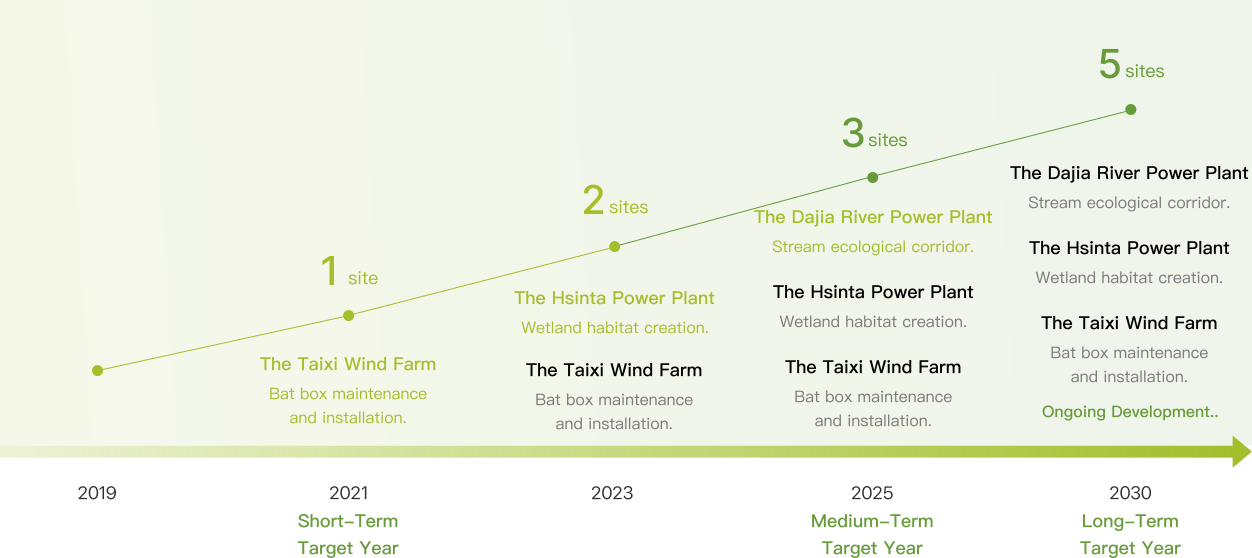
Investments and Achievements in Ecological Conservation and Biodiversity

Wan-da Power Plant
- Environmental education facility and venue: Certified in May 2017./li>
- OECM certification: Certified in December 2015 as an Other Effective Area-Based Conservation Measure (OECM).
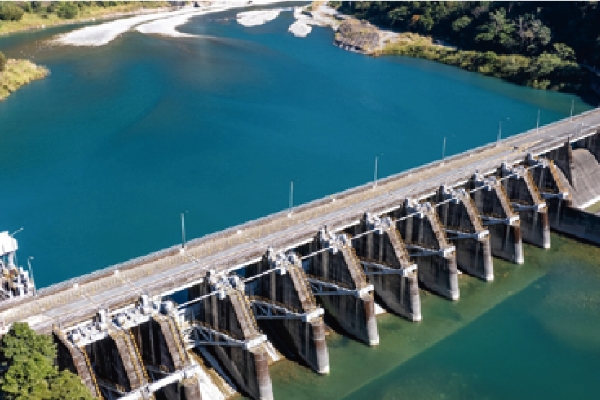
A home for fish migration and the return of a clear stream ecosystem
- Environmental education facility and venue: Certified in October 2022.
- OECM certification: Certification expected in 2026.
- 9th National Environmental Education Award: Awarded on June 26, 2024.
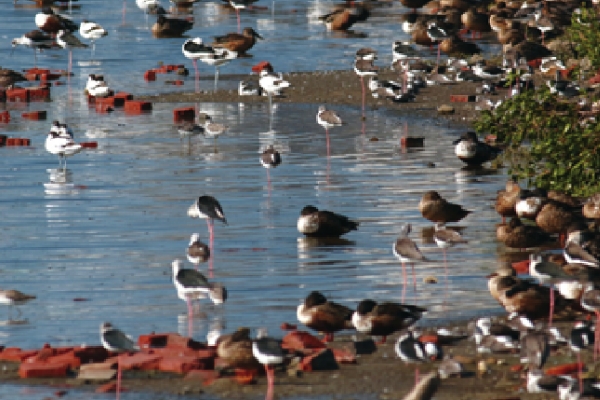
A haven for birds and the light of the Yongan Wetland
- Environmental education facility and venue: Certified in September 2024.
- National Sustainable Development Award: Application planned for 2026.